Commensal rodent pressure across Franklin County peaks as autumn temperatures drop below 45 degrees Fahrenheit, driving wild populations of house mice and Norway rats directly toward conditioned crawlspaces and rim…
Commensal rodent pressure across Franklin County peaks as autumn temperatures drop below 45 degrees Fahrenheit, driving wild populations of house mice and Norway rats directly toward conditioned crawlspaces and rim joists. The architectural history of Columbus creates distinct structural vulnerabilities that generic surface poisons fail to resolve. Historic fieldstone foundations in German Village, century-old rubble-fill stone basements in Victorian Village, and brick subterranean basements in Olde Towne East routinely feature missing mortar joints where foundation settling occurs. According to guidance from the Centers for Disease Control and Prevention, eliminating structural gaps wider than one-quarter of an inch is the single mandatory step to stop rodent ingress. A juvenile house mouse requires a clearance opening of merely six millimeters, roughly the diameter of a standard pencil, to compress its ribcage and enter a warm wall void, while a mature Norway rat pushes through twelve-millimeter apertures along utility line entries.
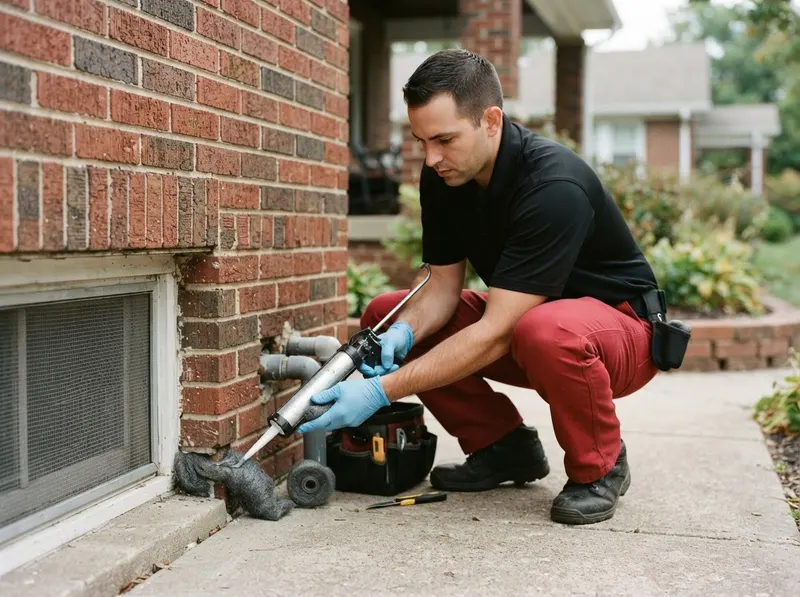
EmberVale Exterminators executes mechanical exclusion as the foundational defense rather than relying on chemical repellant treatments. Chemical applications merely attempt population suppression while leaving structural conduits open, which leads directly to secondary indoor rodent deaths, wall-void decay, and secondary infestations of dermestid beetles. Our structural exclusion methodology utilizes heavy-duty materials rated to resist rodent gnawing incisors, which exert bite forces exceeding 7,000 pounds per square linear inch. We install 19-gauge galvanized hardware cloth across low-elevation crawlspace vents, pack copper wire mesh inside exterior weep screeds, and seal conduit penetrations using exterior-rated, non-shrinking polyurethane foam infused with metallic fibers. Guidance from the Environmental Protection Agency on Integrated Pest Management demonstrates that non-chemical physical exclusions establish longer-term control than recurrent ambient pesticide applications.
Suburban homes bordering ravine corridors in Clintonville, wooded lots in Worthington, and older stone foundations in Upper Arlington, Bexley, and Grandview Heights face sustained subterranean pressure from subterranean burrows. When river-adjacent commercial corridors in Franklinton and the Short North Arts District experience construction disruption, displaced rats follow shared sewer infrastructure and telecommunication conduits directly into subflooring. The North Carolina State Extension notes that interior traps capture resident pests only after external perimeter containment locks out foraging replacements. EmberVale Exterminators anchors heavy-duty, tamper-resistant rodent stations along property perimeters to monitor wild populations while internal mechanical snap traps set inside joist bays extract resident specimens within 24 to 72 hours, eliminating the risk of unattended rodent decay beneath floorboards.
Physical restoration of the building envelope requires targeted carpentry and masonry intervention. Damaged rubber garage door astragals are replaced with commercial-grade, steel-reinforced weather sweeps that sit flush against uneven concrete aprons, adhering to structural rodent-proofing standards outlined by the Oregon Department of Agriculture. Attic rooflines along soffits and fascia returns are reinforced against roof rats using precision-bent aluminum flashing secured with stainless steel exterior fasteners. For historic residences near the Scioto Mile Promenade or Franklin Park Conservatory, these barrier defenses preserve exterior structural character while denying access to vectors carrying leptospirosis, hantavirus, and salmonella as documented by the Indiana Department of Health. Detailed sanitation protocols remove rodent urine scent trails and pheromones, which prevents outside colonies from zeroing in on former entry voids.
Every job gets a firm, written price after a free on-site visit.
Tell us about your rodent control and structural exclusion job in Columbus and we'll send a clear, written quote, usually the same day.
 EmberVale Exterminators